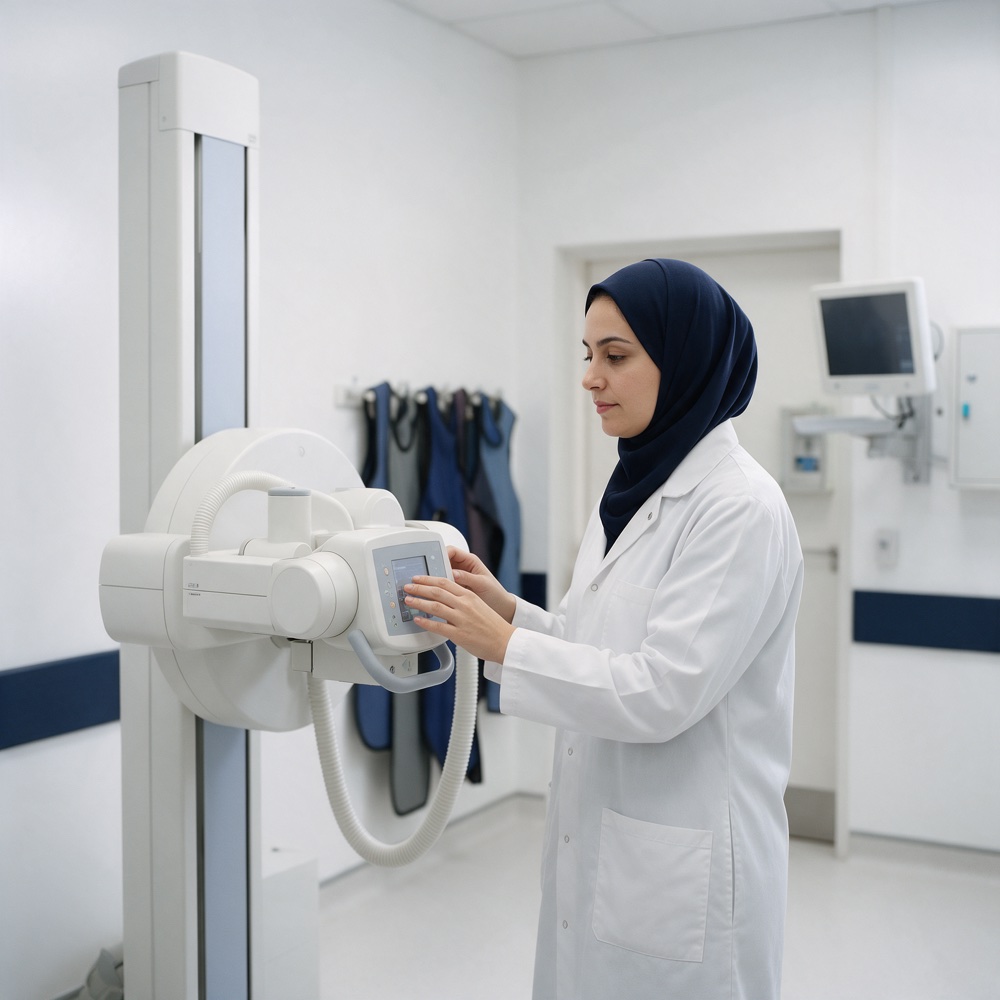

The obstetrics and gynecology doctor at Al-Taawun Branch. Consultations, follow-up, ultrasound and the fitting of family planning methods are all done by her at the clinic.
The laboratory and the radiology department are inside the same branch — so the test, the ultrasound and their results usually happen in the same visit, with no outside referral and no second appointment.
The clinic covers four main tracks, each with its own tests and follow-up:
Regular follow-up that includes blood pressure and weight checks, routine pregnancy tests, and monitoring the baby’s growth by ultrasound at every stage, with setting the expected due date and following up any symptoms that need attention.
The difference between a regular and a detailed ultrasound is that the first follows growth, heartbeat and the amount of fluid, while the detailed scan examines the baby’s organs one by one — the heart, brain, kidneys and spine — and is usually done between weeks 18 and 22. A 4D ultrasound shows the baby’s features clearly.
Assessing the causes of delayed pregnancy in both partners, monitoring ovulation by ultrasound through the cycle, testing fertility-related hormones, and assessing polycystic ovaries and menstrual irregularities.
A consultation to choose the method that suits your health and your plans, then fitting at the clinic in a simple procedure. This includes the contraceptive implant and both types of IUD, with an explanation of what to expect after fitting, follow-up when needed, and removal at the right time or whenever you wish.
Follow-up for the mother after delivery, and a breastfeeding support program to help you start correctly and deal with any difficulties in the first days, as well as following your recovery, the return of your period, and choosing a family planning method suitable while breastfeeding.
Diagnosing and treating recurrent uterine and vaginal infections after pinpointing their cause, instead of random treatment, and treating vaginal dryness and its troublesome symptoms — a common complaint that can be treated.
The cervical smear (PAP smear) is a simple test done at the clinic that detects early changes in the cells of the cervix before they turn into a problem. Cervical ulcers are also treated at the same clinic.
Assessing the causes of recurrent miscarriage through hormone, clotting and immunity tests, and setting a closer follow-up plan for the next pregnancy. Follow-up includes fetal heart monitoring and early detection of signs of preterm labour.
Because the laboratory is in the same building, most tests needed at the gynecology clinic are drawn and read in the same visit or within a short time, including:
A blood test drawn from the mother only — non-invasive and carrying no risk to the baby — that assesses the likelihood of chromosomal abnormalities such as Down syndrome. It is done from about week 10, and it is not mandatory for every pregnant woman; the doctor decides whether it suits your case.
AMH to measure ovarian reserve, follicle-stimulating hormone (FSH) and luteinizing hormone (LH), prolactin, estradiol and progesterone, and thyroid hormones — essential in assessing menstrual irregularities and delayed pregnancy.
Complete blood count (CBC), blood group, Coombs test, gestational diabetes, vitamin D, rubella and toxoplasma — all drawn in the branch as part of routine pregnancy follow-up.
Apart from urgent cases, the routine visit on its own picks up many things early — anemia, gestational diabetes and vitamin D deficiency are all found with a simple test before they cause symptoms.
The contraceptive implant is a long-term method placed under the skin of the arm in a simple procedure that does not take long, done under local anaesthetic at the clinic. Many women choose it because it does not need remembering every day.
At Al-Taawun Branch, the first step is always a consultation — the doctor reviews your medical history, any medicines you take and your pregnancy plans, because the most suitable method differs from case to case. After fitting, follow-up appointments are set, and removal remains available whenever you wish.
The IUD is another long-term method, placed inside the uterus, and comes in two types: the copper IUD, which works without hormones, and the hormonal IUD, which may lighten heavy periods for some women. Choosing between the IUD and the implant depends on your health and how long you want contraception for — and that is what the consultation decides.
We wrote a detailed guide explaining how the implant works, what to expect after fitting, when it starts working, and answers to the most common questions about it.
If you are unsure between more than one method, book a consultation first. The doctor explains the differences between them and helps you choose based on your case, not on what is popular.
What exactly it checks, and the best time for it.
A non-invasive test to assess fetal abnormalities — when it is done and what it shows.
A complete guide to improving your chances of pregnancy and tracking your cycle.
The key tests from the first month to delivery.
Causes, symptoms, diagnosis and treatment.
The best time to have it, and what it shows.
The implant is placed under the skin of the arm and works with a single hormone, while the IUD is placed inside the uterus and comes in two types: the copper IUD without hormones, and the hormonal IUD, which may lighten heavy periods. Choosing between them depends on your health, your cycle and how long you want — and the doctor decides this in the consultation.
The duration varies with the type of IUD, and the doctor sets it at fitting based on the type used for your case. Removal is available whenever you wish before the period ends; it is done at the clinic in a simple procedure, and fertility returns afterwards.
It is preferably fitted during your period or right after it, because the cervix is more ready and to make sure there is no pregnancy. A consultation and examination are done before fitting, and the doctor may ask for an ultrasound to check the position of the uterus.
Yes. It includes following up the mother after delivery, helping her start breastfeeding correctly and dealing with common difficulties in the first days, as well as choosing a family planning method suitable while breastfeeding.
A recurrent infection is usually not solved by repeating the same treatment, but by first finding its cause through examination and the necessary tests. Once the cause is known, a suitable treatment plan is set, and vaginal dryness and its symptoms are treated too.
2D ultrasound for routine follow-up, the detailed ultrasound to examine the baby’s organs closely, and 4D ultrasound, as well as abdominal and pelvic ultrasound. All are done in the branch’s radiology department.
A regular ultrasound follows the baby’s growth, heartbeat, position and the amount of fluid around it. The detailed ultrasound examines the baby’s organs one by one — the heart, brain, kidneys, spine and limbs — looking for any congenital abnormality. It is more precise and takes longer, and is usually requested once in the pregnancy.
Its timing is set according to your case — around the fifth month. This is when the baby’s organs are formed enough to be examined, while its size still allows them to be seen clearly. The doctor sets the best date for your case.
The best time for a 4D ultrasound is usually between weeks 18 and 24, when the baby’s features have formed and there is still enough fluid around it for a clear image. It is a scan for reassurance and to see the features, and it does not replace the detailed ultrasound.
It is a blood test drawn from the mother to assess the likelihood of chromosomal abnormalities in the baby, such as Down syndrome. It is non-invasive, carries no risk to the baby, and is done from about week 10. It is not mandatory for every pregnant woman — the doctor decides whether it suits you based on your age, medical history and the results of other tests.
Yes, and it is drawn in the branch’s own laboratory with no outside referral.
A cervical smear is a simple test in which a small sample of cells is taken from the cervix for laboratory examination, to detect any early change before symptoms appear. It takes only minutes and is recommended regularly for married women — the doctor sets the right interval based on your age and the results of previous smears.
Recurrent miscarriage calls for a different assessment from a single miscarriage, usually including hormone tests, blood clotting and immunity tests, and imaging of the uterus. The aim is to find a treatable cause before the next pregnancy and to set a closer follow-up plan. Book a consultation before planning your next pregnancy.
A test that measures ovarian reserve and helps assess fertility and predict the response to treatment in cases of delayed pregnancy. It is drawn in the branch laboratory and does not require fasting.
Ovulation monitoring means scanning the ovary by ultrasound several times during the cycle to pinpoint the time of ovulation and the size of the egg. It is usually used in cases of delayed pregnancy or irregular cycles, and may be combined with hormone tests to complete the picture.
Yes. It is fitted at the clinic in a simple procedure under local anaesthetic, after a consultation that decides whether the implant suits your case. Follow-up after fitting and removal whenever you wish are also available.
The fitting is done under local anaesthetic, so you do not feel pain during the procedure itself. Afterwards there may be slight swelling or a bruise at the site, which goes away within days. The doctor explains what to expect before starting.
Yes, removal is available whenever you wish, and it is done at the clinic in the same way as the fitting.
There is no single answer that suits everyone. The choice depends on your medical history, the medicines you take, your pregnancy plans and whether you are breastfeeding. The consultation at the clinic is what settles it.
The first step is an assessment visit that includes your medical history, hormone tests and ovulation monitoring by ultrasound. A test for the husband may also be requested, because the cause of the delay can be on either side.
Booking in advance is preferred to secure a suitable time, through the unified number 920002278 or WhatsApp. The obstetrics and gynecology clinic works two sessions: from 9:00 AM – 12:00 PM and from 4:30 PM – 9:30 PM, Saturday to Thursday.
Usually yes. The laboratory is in the same building, so the sample is drawn right after the consultation, and many results come out quickly and are discussed with the doctor.
Two sessions a day, Saturday to Thursday: from 9:00 AM – 12:00 PM, and from 4:30 PM – 9:30 PM. Booking in advance is preferred so you can choose the time that suits you.
Al-Taawun Branch — unified number 920002278 · Clinic hours: 9:00 AM – 12:00 PM and 4:30 PM – 9:30 PM
The medical content on this page is for general awareness and does not replace a consultation with the doctor or a diagnosis. The right tests are decided after the assessment at the clinic. Bookings and enquiries: 920002278 — All Al-Taawun Branch clinics · Current offers · The medical team.
We are distinguished in the Medical World Clinics Polyclinic by having a group of distinguished doctors in all medical specialties